Flared Jeans for Curvy Figures: Fit and Styling Guide
Flared jeans have a reputation for being demanding: the wrong pair pulls across the thigh, gapes at the waist or adds bulk exactly where you don't want it. Get the proportions right, though, and flares are one of the most flattering shapes going. They lengthen the leg, balance a fuller hip and give any outfit a bit of retro swagger. The trick isn't a secret brand. It's knowing which details to look for before you get near a fitting room.
Start with the rise
The rise decides whether a pair of flares stays put. For most curvy figures — particularly those with a defined waist and fuller hips and thighs — a high rise is the easiest place to start. Look for a front rise that sits at or just above the navel, roughly 10 to 12 inches depending on your height and torso. A higher rise covers the hip and holds the waistband level, so you're not constantly tugging at the back.
Mid-rise can work beautifully too, but check the back rise. Some pairs are cut lower at the front and higher at the back, which suits a curvier seat far better than a uniformly low waistband. Low-rise flares are the trickiest: they sit below the widest part of the hip, which can create a slight overhang even when nothing is actually spilling.
Whatever the label says, sit down in them. A waistband that feels fine standing up can dig in the moment you fold at the middle. If it gapes at the back, that's a fit issue, not a you issue.
Fabric and stretch: how much give you actually need
Denim with a small amount of elastane is your friend, but more is not automatically better. Around 1 to 2 per cent elastane gives enough movement to sit, bend and eat lunch without the jeans losing their shape. Push past 3 per cent and the denim can bag at the knee and seat by mid-afternoon, which ruins the clean line a flare depends on.
Rigid 100 per cent cotton denim is worth trying if you like a structured look. It holds the flare shape beautifully and smooths the thigh, but it takes a few wears to soften and won't forgive a wrong size. A middle ground is a cotton-rich blend with a touch of polyester and elastane — often sold as comfort stretch — which moulds without going slack.
- Too tight? Look for horizontal creases pulling across the front of the hip. That's strain, not fit.
- Too loose? If you can pinch more than a couple of centimetres at the side seam, size down.
- Test it: Squat, climb a pretend stair and sit for a full minute before you decide.
Pocket placement does more than you think
Back pockets are the quiet workhorses of any pair of jeans. A pocket that sits too low drags the eye downwards and makes the seat look longer than it is. One that's too small looks out of proportion on a fuller bottom; one that's too large can flatten it. Aim for medium-sized pockets positioned so they're roughly centred over the fullest part of your seat, with a very slight angle.
Skip flaps, heavy stitching, rhinestones and contrast logos unless you actively want attention there. A clean pocket in the same wash as the denim is the most reliable choice. Front pockets matter too: deep ones are useful, but a neat, flat front won't add bulk. If a pair has bulky coin pockets or a lot of whiskering across the thigh, that's visual volume you don't need.
Fit through the hip, thigh and knee
Flared jeans should be fitted — not tight — from the waist through the hip and thigh, then follow the leg closely to the knee before opening out. That change of direction at the knee is what creates the flare's long, lean line. If the denim is baggy at the knee, the flare just looks like a wide trouser. If it's tight, you'll get pulling and creases that break the shape.
Pay attention to the thigh. A little room is fine; a strained, shiny patch at the front is not. If you're between sizes, buy for the largest part of you — usually the hip or thigh — and have the waist taken in. A tailor can adjust a waistband far more easily than they can add fabric to a thigh.
Flare width, hem length and shoes
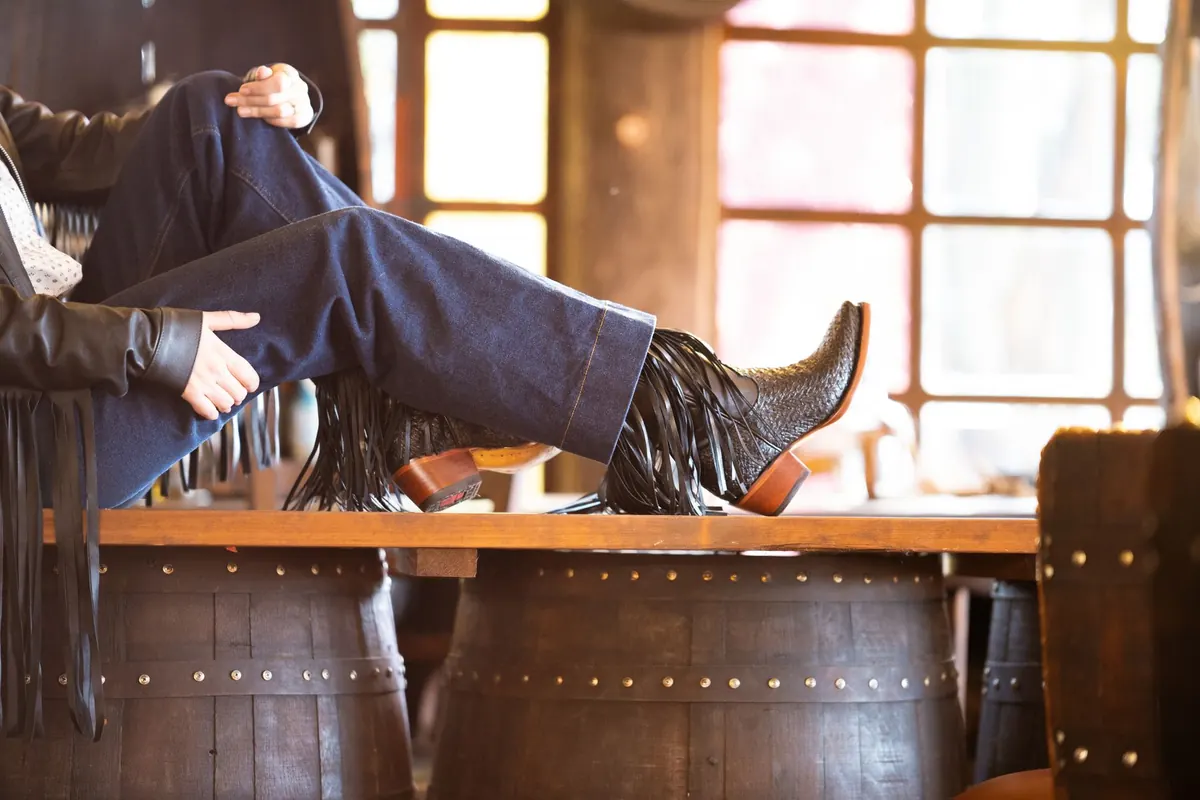
A gentle flare — one that opens only a few inches wider than the knee — is the most versatile and the easiest to wear with flat shoes. A dramatic flare is a statement, and it works best with a heel, a platform or a chunky boot to keep the hem from puddling.
Hem length is where most people go wrong. The back hem should skim the top of your shoe, or break just once over it. If you plan to wear the jeans mainly with heels, take them to the fitting room with you. If you'll wear them with trainers, hem them to that height instead. A good pair of flares is worth a trip to a tailor; taking 2cm off the hem changes the whole silhouette.
Petite and tall notes
If you're petite, a slightly narrower flare and a higher rise will keep the leg looking long. If you're tall, you can carry a wider flare and a longer inseam without the shape being overwhelmed. Either way, check the inside leg measurement rather than trusting the label.
Tops and layers that balance the silhouette
Flares add volume below the knee, so the top half needs to hold its own without competing. A few combinations that reliably work:
- A fitted knit tucked in. A fine-gauge jumper or a bodysuit tucked into a high-rise flare gives a clean waist.
- A cropped jacket. A denim jacket, biker jacket or short blazer that ends at the waist keeps the proportions sharp.
- A half-tuck. Tuck the front of a longer shirt and let the back hang. It defines the waist without feeling too done.
- An open layer. An unbuttoned shirt or long cardigan over a fitted top creates two vertical lines, which lengthens the body.
What tends to fight a flare: long, loose tunics that end at the widest part of the thigh, boxy tops that hit mid-hip, and oversized shirts worn fully untucked. None of these are forbidden — but if you feel shorter or wider than usual, the top length is often the reason.
A fitting-room checklist
- Put them on and sit down. Check the back waist for gaping and the front for digging.
- Stand sideways in the mirror. The line from hip to knee should be smooth, then flare gently out.
- Check the back pockets in a full-length mirror. Are they centred on the fullest part of your seat?
- Walk a few steps and squat. Look for pulling at the knee and creasing across the thigh.
- Try them with the shoes you'll actually wear. Hem length changes everything.
- If the hips fit and the waist doesn't, buy them anyway. A tailor can fix the waist.
Making flares work for you
The best flared jeans for a curvy figure are the ones you forget you're wearing. That usually means a high or well-cut mid rise, denim with just enough stretch to move but not enough to sag, pockets in the right place, and a top that finishes at a flattering point. Start with one dark-wash pair in a gentle flare, wear them for a week, and notice what you reach for. Once you know your rise, your ideal hem and your preferred flare width, shopping gets a lot quicker — and a lot less frustrating.
Photo: rawqstudio / Pixabay

You Might Also Like
From Gloucester Road's charity-shop trail to Sunday swaps in Southville, here's how to hunt, repair and trade retro fashion finds across Bristol.
A practical guide to the vintage cues — silhouette, fabric, colour and accessories — that make an outfit read retro rather than fancy dress, plus how to style them for everyday wear.